Healing & Belief Systems
As we have already seen, healing — whether expressed as contact healing, distant healing, faith healing (here referring to religion-specific traditions), the laying-on-of-hands, or spiritual healing — has formed part of human culture for many millennia. Across civilizations and continents, healing has rarely been viewed as purely physical; rather, it has often been understood as a spiritual, relational, or cosmological act.
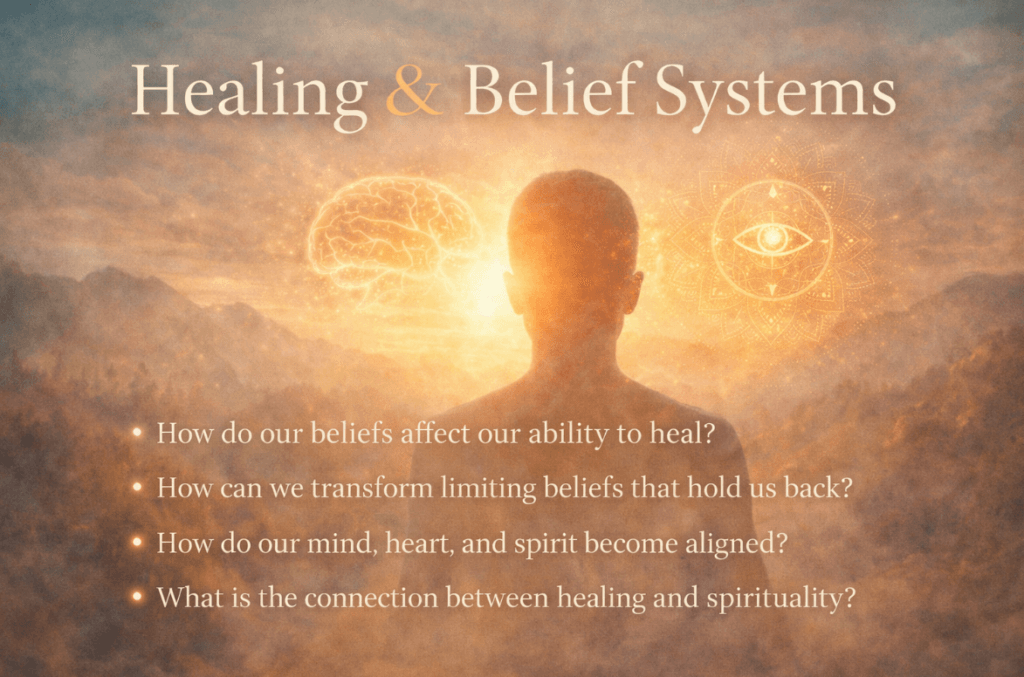
What follows are examples of how healing is perceived within a selection of doctrinal and other belief systems.
Christianity
Beliefs about healing vary widely across the many Christian denominations. Some traditions emphasize divine intervention, prayer, and the laying-on-of-hands as central expressions of faith. Others place greater emphasis on pastoral care and the integration of prayer with conventional medicine.
Biblical accounts of Jesus and the apostles performing acts of healing continue to influence contemporary Christian understandings, although interpretation and practice differ significantly between sects.
Judaism
The Jewish Association of Spiritual Healers (JASH) recognizes spiritual healing as part of Jewish history and tradition. References to healing acts appear in the Hebrew Scriptures (Old Testament), and such practices are understood to be permissible under Jewish law (Halacha).
Judaism places strong emphasis on both prayer and ethical living, while also historically valuing medical scholarship. Healing is not seen as separate from personal responsibility or community support, and conventional medicine is fully embraced within Jewish life.
Islam
In Islam, Allah is understood as the Ultimate Healer. Spiritual healing is recognized as a legitimate means of addressing both physical and spiritual ailments. The Qur’an itself is believed to possess healing qualities, both through its recitation and its guidance.
Islamic civilization has a long and distinguished history of medical scholarship, regarded as knowledge ultimately derived from Allah. In many Muslim contexts, faith and medicine are seen as complementary rather than oppositional. The phrase found in some Islamic hospitals — “We care, but God heals” — reflects this close relationship between religious belief and medical practice.
Voodoo
Originating in West Africa and estimated to be thousands of years old, Voodoo (from vodoun, meaning “spirit”) is among the world’s oldest spiritual traditions. It spread to the Caribbean and the Americas through the transatlantic slave trade.
In Voodoo cosmology, illness is often understood as having a spiritual origin. Healing therefore involves engagement with the spirit world, particularly through the Lwa (spirit beings). Ritual is central and may incorporate prayer, drumming, dance, herbal remedies, medicines, and sometimes surgical techniques. Spiritual and physical elements of healing are interwoven rather than separate.
Spiritualism
Spiritualism teaches the progression of the human soul and is grounded in Seven Principles that underpin its spiritual philosophy. Services commonly include demonstrations of mediumship, offered as evidence of the continuity of life beyond physical death.
Healing within Spiritualism is believed to originate from a divine source. The healer is seen as a channel through whom healing energies are directed, often understood to be guided by intermediaries in the Spirit world — sometimes described as spiritual guides, healing ministers, or doctors who may or may not have practiced medicine during earthly life.
Shamanism
Shamanic practices represent some of the earliest recorded organized belief systems, with origins stretching back tens of thousands of years. Shamanism is often described as one of humanity’s oldest healing traditions.
Like Voodoo, it frequently views illness as spiritual in origin. Healing typically involves the shaman entering an altered state of consciousness — through drumming, chanting, fasting, plant medicines, or other means — in order to communicate with spirit beings from the Upper or Lower Worlds. These spirit allies may appear in human, animal, or symbolic forms and assist in restoring balance to the individual and the community.
Taoism
As a philosophy or way of living, Taoism predates formal religious Taoism by approximately 1,500 years, with early writings emerging around 2000 BCE. The Tao (Dao) often translated as “The Way,” is described paradoxically: “The Tao that can be spoken is not the eternal Tao” (Lao Tzu).
Health and wellbeing arise from harmony within the dynamic balance of Yin and Yang and the interplay of universal forces and earthly elements. Practices that cultivate balance — including acupuncture, herbal medicine, breathwork, movement disciplines, and massage — form the foundation of Traditional Chinese Medicine. In Taoist thought, spiritual and physical dimensions of healing are inseparable; they are expressions of the same underlying reality.
Druidry
Druidry is an ancient, spiritually based tradition rooted in oral history, likely evolving from earlier pagan and shamanic practices. Its origins are obscured by time, but modern Druidry is widely recognized as a nature-based spirituality and cultural path.
Healing is considered one of the Seven Gifts of Druidry and is traditionally associated with the Ovates — one of the three branches of Druidry (alongside Bards and Druids). Historically, an Ovate was regarded as a healer, seer, prophet, and diviner. In contemporary practice, Ovates may study or practice herbalism, healing, and divination within a Druidic framework, blending spiritual insight with practical knowledge of the natural world.
Zoroastrianism
Founded by Zoroaster (Zarathustra) in ancient Iran approximately 3,500 years ago, Zoroastrianism is one of the world’s oldest monotheistic religions. It worships Ahura Mazda (“Wise Lord”) as the creator of the world, and its sacred text is the Avesta.
The guiding principle — Good Thoughts, Good Words, Good Deeds (Humata, Hukhta, Huvereshta) — places strong emphasis on ethical conduct and personal responsibility. In some interpretations, illness has occasionally been viewed as connected to moral imbalance; however, prayer is widely regarded as possessing healing power, particularly when offered in the presence of the person who is ill. Zoroastrians are also fully accepting of conventional medical treatment.
Paganism
Paganism is a broad and diverse spiritual movement encompassing many traditions and practices. While beliefs vary, common principles often include:
- Respect for nature
- Honour for gods and goddesses
- Recognition of life’s cycles
- Commitment to an ethical or moral code
Healing within Pagan traditions takes many forms. It may include spiritual healing, herbalism, folk remedies, ritual practices, and a wide range of holistic approaches. As with many earth-based spiritualities, healing is typically understood as a process of restoring balance — within the individual, the community, and the natural world.
The Healer’s Journey
In your journal you will find a section on Healing and Beliefs. Take time to contemplate the questions you find there. It will be really interesting to look back on this section later in the year or at the end of your training.