Subtle energies, the chakras and the aura
Sensing Energies
Have you ever visited a place—a monument, a famous landmark, a church or other sacred site—and felt it had a “presence” or character of its own? Battlefields and places associated with human suffering can carry a noticeable atmosphere too.
Have you ever met someone for the first time and felt an immediate like or dislike, with no obvious reason?
At a simple level, these are everyday examples of sensing energies: the energies of place, and the energies of people.
Our physical bodies give us five basic senses—touch, taste, hearing, smell, and sight—through which we experience the world on the physical plane, each in our own unique way. In daily life we’re also bombarded by an avalanche of information (TV, radio, internet, advertising, work, social contact). We filter most of it out automatically. It’s not surprising, then, that we may not notice information arriving in subtler ways.
There’s a common observation that babies and very young children appear more responsive to subtle cues than adults. They haven’t yet learned to screen their environment so thoroughly. You can sometimes see this when a young child studies another person: they don’t only focus on face and body, but seem to attend to the space around the person too. Are they sensing an aura? If so, what might they be perceiving?

Alongside our physical senses, many healing traditions describe a subtle energy system with its own ways of “knowing.” Just as a wine expert refines taste and smell, or a musician refines hearing, we can refine how we perceive subtle energy through practice. Some people experience this as a natural gift, and may perceive energy as:
- Visual impressions (clairvoyance)
- Physical sensations or emotions (clairsentience)
- Sounds or inner hearing (clairaudience)

With practice, most people can strengthen their ability to sense energies—in their own way.
How energy is sensed varies widely. One person may feel heat or tingling, while another senses coolness, pressure, or a gentle breeze. Just as we see colour differently in the physical world, we may also “see” or interpret energy differently in the subtle world.
Some people worry that if they can’t clearly sense energy, they can’t be effective healers. This is rarely the case. Much like healing itself, sensing energy is an interaction that may already be happening—someone simply may not recognize when it is happening, or how it shows up for them. Often, it’s a matter of learning to soften the dominance of the five physical senses enough to notice subtler information beneath the background noise.
The Subtle Energies
“The visible world is the invisible organization of energy.” — Heinz Pagels
Harry Edwards did not promote a single, fixed belief about subtle energy systems, although he was aware of them. His approach to healing emphasized the simplicity of the healing act and the importance of clear mental intention: to relieve symptoms, address the condition, and attend to the original cause—whether mental, physical, or emotional.
“Subtle energy systems” refers to aspects of being described as beyond physical measurement, and which may or may not be magnetic, electrical, or electromagnetic in origin. At present, there is no definitive Western scientific consensus recognizing these systems as objectively measurable realities.
These traditions often describe human beings as vibrational in nature. This is sometimes expressed (not always carefully) through the idea that physical matter is in constant motion at different frequencies—across a spectrum that includes visible and invisible light, sound, electromagnetism, gamma rays, and more. Esoteric descriptions vary widely, so discernment is important when reviewing different sources.
In many teachings, subtle energy is described in terms of light (“light beings”) and/or spiritual development—where “higher vibration” is associated with greater harmony, awareness, and alignment with universal principles or consciousness.
Subtle energy systems are also sometimes described as multidimensional (more than physical dimension) or transdimensional (existing across dimensions, beyond time). These ideas can feel elusive at first, but understanding often grows through experience and practice.
Several ancient cultures built entire healthcare systems around subtle energy anatomy, usually within a broader view of connected life or universal consciousness (Kapchuk (2000) calls it “the web that has no weaver”). Many of these systems are detailed and precise in how they map health and disease. With modern fields such as psychoneuroimmunology and research into anomalous experiences, contemporary science is beginning to explore questions that older traditions have engaged with for centuries.
The Aura
The aura appears across many esoteric teachings, including ancient Indian philosophy (Upanishads and Vedas), ancient Greek philosophy, the Judaic Kabbalah, later Theosophical works (e.g., Madame Blavatsky), and the writings of Rudolf Steiner. It is also elaborated in modern works such as those of Barbara Ann Brennan and Martin Brofman.
Most descriptions refer to “layers” of the human energy field, beginning close to the physical body and becoming progressively more subtle and transcendent outward from the body. Interpretations vary widely, both in the number of layers and their meanings.
Based on Barbara Ann Brennan (1987), the auric layers are often described like this:
| Auric Layer | Linked Chakra | Plane of Awareness | Interpretation |
|---|---|---|---|
| Etheric | Base | Physical Plane | The physical aspect of being |
| Emotional | Sacral | Physical Plane | Associated with feelings |
| Mental | Solar Plexus | Physical Plane | Mental processes and thought-forms |
| Astral | Heart | Bridge | Spiritual connection |
| Etheric (Blueprint) | Throat | Spiritual Plane | Extradimensional blueprint |
| Celestial | Brow | Spiritual Plane | Connection with universal consciousness |
| Ketheric / Causal | Crown | Spiritual Plane | Integration with universal consciousness |
The Chakras
The Harry Edwards Healing College uses the chakras as a primary focus for directing healing energy, in line with UK Healers standards.
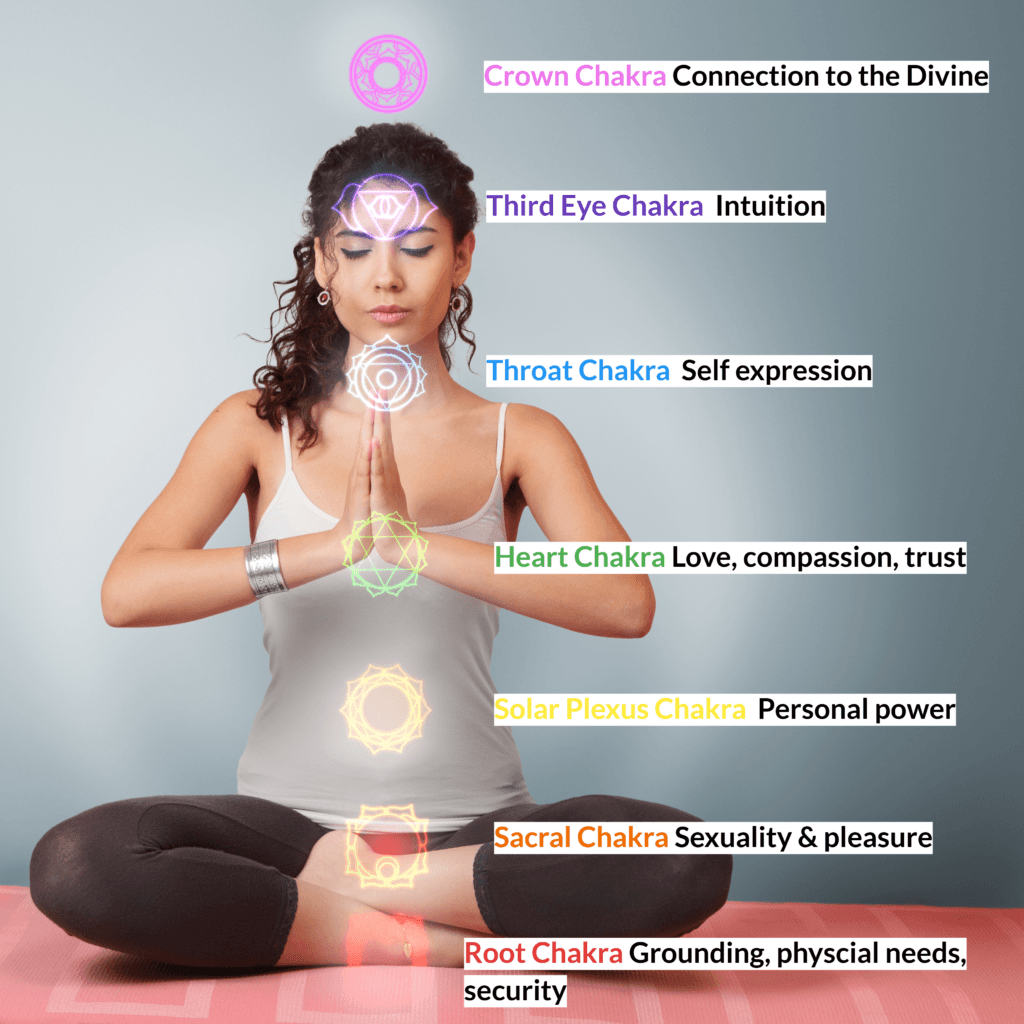
From Ayurvedic texts comes the concept of the chakra—Sanskrit for “wheel”—an energy centre. In most systems there are seven major chakras, aligned in an ascending column from the base of the spine to the crown of the head.
While descriptions vary (because not everyone perceives subtle energy in the same way), there are more similarities than differences across traditions.
Chakras are often described as connected to the spine through plexuses of roots, with a flower-like appearance, and linked to glands in the endocrine system. Each chakra is described as a receiver, assimilator, and transmitter of energy. In some traditions, chakras are said to gather, absorb, transform, and redistribute energy—bringing higher vibrations toward the physical plane and translating them into forms we can assimilate. Pranic life force and spiritual information are described as moving through the chakras and into the body via nadis, sometimes compared to petals within each chakra. Each chakra is also influenced by those above and below it.
When chakras open, people may report a surge of energy—sometimes compared to a camera lens widening, or a centrifugal movement. When they close, the energy pattern is described as returning gently to its usual state.
Base Chakra
Sanskrit: Muladhara
Located at the base of the spine. Associated with survival, grounding, and basic life force. Often described as red, linked with earth and physical reality, and connected to the adrenal glands. Commonly associated with the etheric body and physical vitality.
Sacral Chakra
Sanskrit: Svadhisthana
Situated a few fingers below the navel. Associated with vitality, creativity, sexuality, and water. Often described as orange, sometimes called the hara, linked with the gonads and reproductive system.
Solar Plexus Chakra
Sanskrit: Manipura
Associated with emotional processing, personal power, and fire. Often linked with the pancreas and described as yellow. Sometimes called the “fuse box,” as it is commonly thought to accumulate stress or negativity. Linked with digestion and the nervous system, and often considered a chakra needing frequent balancing.
Heart Chakra
Sanskrit: Anahata
Governs the heart and is often described as the bridge between the lower (more survival-oriented) chakras and the upper (more spiritual) chakras. Associated with compassion, connection, and divine love. Often linked with the thymus, described as green, element air. For many healing traditions, balanced heart energy is central to effective healing.
Throat Chakra
Sanskrit: Vishuddha
Located at the throat and associated with communication, expression, and truth. Often linked with the thyroid and parathyroid glands, described as blue, element sound. Connected with issues of trust and speaking one’s truth.
Brow Chakra
Sanskrit: Ajna
Known as the “third eye,” located between the eyebrows. Associated with perception, discernment, intuition, and insight. Often linked with the pituitary gland and described as indigo, element light.
Crown Chakra
Sanskrit: Sahasrara
Located at the crown of the head. Associated with connection to higher consciousness, universal life force, and spiritual integration. Often linked with the pineal gland and described as violet, element thought. Some traditions refer to it as a meeting place between body and soul.
Each chakra is also sometimes described as having its own pulse rate or vibrational frequency. The opening of chakras is generally approached systematically, and for healers and clients alike, the key principle is BALANCE.
The Connection Between Physical, Mental, Emotional, and Spiritual Self
Many ancient cultures recognized a relationship between body, mind, and spirit, understanding each as part of an integrated whole. One affects the others. Today, integrative medicine and health psychology increasingly acknowledge that health is influenced not only by the physical body, but also by mental, emotional, and spiritual aspects. In this course we will use a cognitive behavioural therapy (CBT) model to explore these links.
Spiritual
The spiritual self is your connection to energy. For some, this is closely tied to religion; for others, it relates more to the language of science—atoms, biology, or quantum concepts. In some views, energy flows from spirit/source/universe and first enters the mental body.
Mental
The mental aspect is more than thoughts: it includes beliefs, values, and goals. These are often shaped early in life.
Emotional
The emotional aspect includes past, present, and anticipated emotional experience. New experiences evoke feelings, often linked to earlier similar experiences.
Physical
The physical body can be understood as a reflection of the other aspects of self. When balance and harmony are disrupted, dis-ease may manifest in the body.
Environment
We also need to include the environment: how we respond to external events is influenced by all aspects of self. Stress, for example, can arise when spiritual, mental, emotional, and physical needs aren’t being met. Stress activates the fight–flight response—useful for immediate threat, but potentially harmful if repeatedly triggered over time.