The Connections of Physical, Mental, Emotional & Spiritual Aspects of the Self
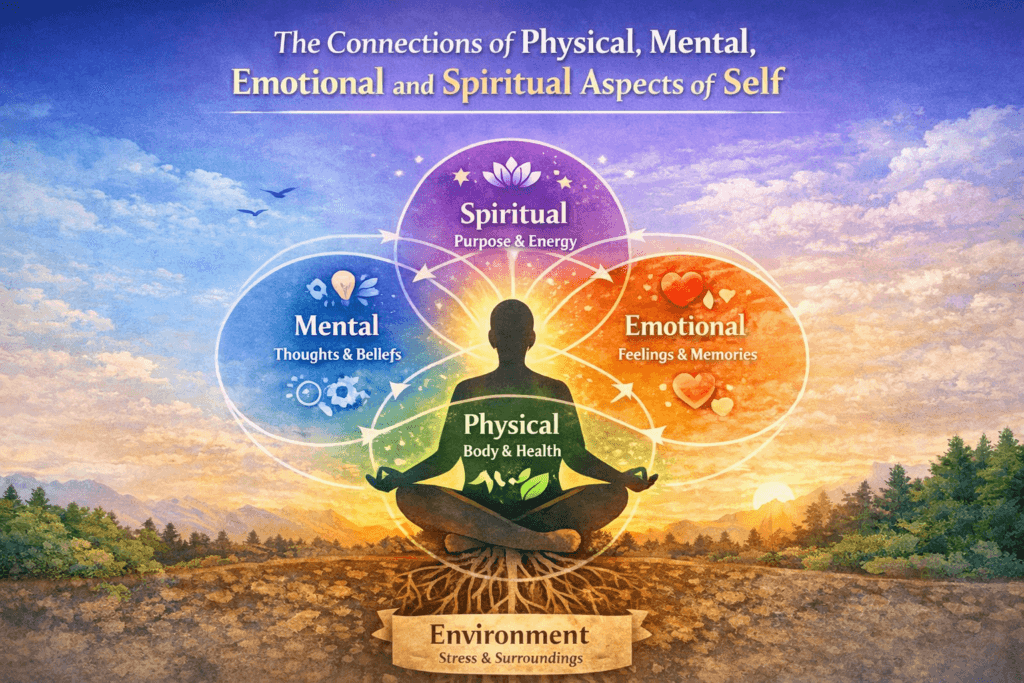
Many ancient cultures understood wellbeing as an interplay between body, mind, and spirit—with each part influencing the others. When one area is under strain, it can ripple through the whole system.
Today, integrative medicine and health psychology also recognise that health is shaped not only by the physical body, but by our thoughts, emotions, meaning-making, relationships, and environment. In this course, we’ll use a Cognitive Behavioural Therapy (CBT) lens to explore these links—how our thoughts, feelings, and behaviours interact with the body and our lived experience.
Spiritual
Your spiritual self is your connection to meaning, purpose, values, and life-force/energy.
- For some people, spirituality is closely connected to religion and faith practices.
- For others, it may be a sense of connection to nature, community, inner wisdom, or the universe.
- Some people relate to spirituality through a more scientific lens—such as the body’s energy systems, awe, or the interconnectedness of life.
However you define it, this aspect often influences how you make meaning of life events, and what helps you feel anchored when things are hard.
Mental
The mental aspect is more than thoughts—it includes your:
- Beliefs (“What I think is true about myself, others, the world”)
- Values (“What matters most to me”)
- Goals and intentions (“What I’m working toward”)
Many beliefs and values are shaped early in life, and can continue to operate in the background unless we bring them into awareness.
Emotional
The emotional aspect includes your past, present, and anticipated emotional experiences.
- Events generate feelings in the moment.
- Those feelings can also activate memories and meaning from earlier experiences.
- Emotions carry information—about needs, safety, connection, loss, boundaries, and desire.
In a CBT framework, emotions are closely linked to both thought patterns and body sensations.
Physical
The physical body is the place where everything meets.
- It reflects what’s happening mentally and emotionally through breath, tension, energy, sleep, appetite, pain, and symptoms.
- When there isn’t balance or support across the system, stress can show up physically over time.
Rather than seeing the body as “separate,” we treat it as an important messenger.
Environment
You don’t exist in a vacuum. Your wellbeing is influenced by your environment—home, work, relationships, culture, and daily demands.
Stress often increases when our needs (physical, emotional, mental, spiritual) are not being met.
- Stress can trigger the fight–flight response, which prepares the body to respond to threat.
- When this system is activated repeatedly without recovery, it can contribute to ongoing strain and chronic symptoms.
Key idea
These aspects are interconnected. Supporting one area (e.g., sleep, boundaries, breath, meaning, self-talk) often helps the others.