The History of Spiritual Healing
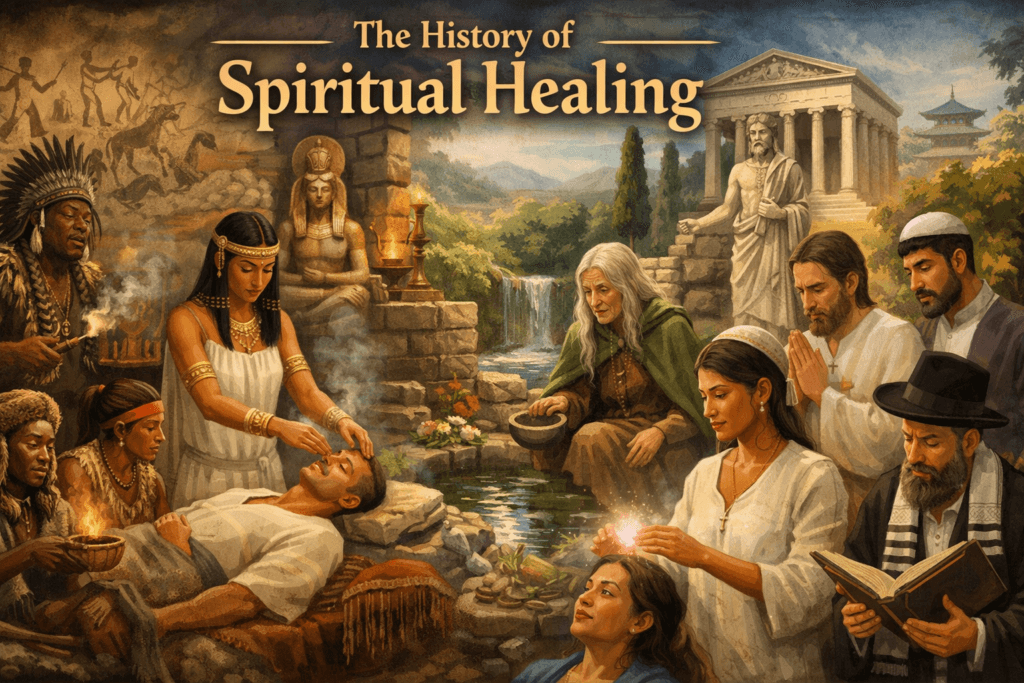
Spiritual healing—broadly understood as the restoration of well-being through connection with transcendent forces, sacred practices, or inner spiritual power—has shaped human cultures for millennia. While its forms differ across traditions, the underlying belief that healing can arise from something beyond the purely physical is widespread. The historical development of spiritual healing reveals a continuous interplay among religion, community, ritual, psychology, and evolving conceptions of mind and body.
1. Origins in Prehistoric and Indigenous Traditions (prehistoric; some evidence over 30,000 years old)
The earliest evidence of spiritual healing appears in prehistoric shamanic traditions, some dating back over 30,000 years. Cave art from Europe, Siberia, and the Americas depicts figures engaged in ritual trance, suggesting early beliefs that illness results from disharmony between the physical and spiritual worlds. Shamans served as intermediaries between human and spirit realms, using drumming, chanting, plant medicines, and visionary states to retrieve lost soul fragments, expel harmful forces, or restore balance.
Indigenous healing systems across Africa, Australia, Asia, and the Americas share similar themes. Among the First Nations of North America, healing circles, sweat lodges, and ceremonial songs emphasize community as a vessel for spiritual restoration. Australian Aboriginal healers, or Ngangkari, work with spiritual energies (kurunpa) to realign emotional, physical, and spiritual health. These traditions highlight a holistic worldview where healing involves relationships with ancestors, land, and the sacred.
2. Ancient Civilizations and Spiritual Medicine
Egypt & Mesopotamia (Egypt: dynastic period approx. 3000–30 BCE; Mesopotamia: early city-states onward, approx. 3200 BCE+)
Ancient Egyptians believed health was maintained through harmony among the body, spirit (ka), and moral order (maat). Temples associated with healing deities and deified healers functioned as centres of ritual purification, dream healing, and incantations. Mesopotamian healers (āšipu) blended prayer, ritual, diagnosis, and herbal remedies, often viewing sickness as the result of spiritual imbalance or divine displeasure.
India: Vedic and Ayurvedic Spiritual Healing (Vedic tradition approx. 1500–500 BCE; Ayurveda developing thereafter)
The Vedic tradition (c. 1500 BCE) viewed illness as arising from disruptions in cosmic order (ṛta). Healing rituals involved mantra recitation, fire ceremonies (yajna), and offerings to deities associated with health. Ayurveda, though medical in structure, rests on spiritual foundations: prana (life-force), karma, and the unity of body, senses, mind, and spirit. Meditation, yoga, and mantra therapy remain essential components of its healing philosophy.
China: Taoist and Qi-based Healing (early roots late 1st millennium BCE onward)
In ancient China, spiritual healing emerged through Taoist practices that sought alignment with the Tao, the natural flow of the universe. Illness signified disharmony between internal energy (Qi) and cosmic forces. Practices such as Qigong, breathwork, and meditation cultivated spiritual vitality, while rituals addressed malevolent influences believed to disrupt energetic balance.
Celtic traditions: sacred waters and place-based healing (Celtic Iron Age approx. 700 BCE–400 CE; Romano-Celtic Britain 1st–4th centuries CE)
Across Celtic regions (Ireland, Britain, and parts of continental Europe), healing was often sought through relationship with place—especially springs and wells understood as sacred, liminal sites where restoration could be approached through reverence, prayer, pilgrimage, vow-making, and offerings. This strand of spiritual healing is strongly tied to land, water, ancestry, and the felt “presence” of certain locations, reflecting an understanding that wellbeing is relational—between person, community, and the living environment.
A well-documented Romano-Celtic example is Aquae Sulis (Bath, England), centred on the thermal spring associated with the goddess Sulis, later linked with Sulis Minerva under Roman rule. The temple complex at Bath is dated to the later 1st century CE (approx. 60–100 CE), and the site functioned as a sanctuary where sacred water, devotion, and communal ritual were interwoven with restoration and health-seeking.
Greece: Temples of Asclepius (Epidaurus: cult established by approx. 6th century BCE; major temple built early 4th century BCE)
Although Greece is credited with rational medicine, spiritual healing remained vital. Pilgrims visited Asclepian sanctuaries to undergo purification, prayer, and incubation—sleeping in the temple precinct to receive healing dreams. The Sanctuary of Asklepios at Epidaurus developed out of an earlier cult during the 6th century BCE at the latest, and the temple was built in the early 4th century BCE. These sanctuaries blended psychological, ritual, and communal elements, illustrating early mind–body–spirit integration.
3. Spiritual Healing in Major Religious Traditions
Buddhism (from approx. 5th century BCE)
Buddhism frames healing as liberation from suffering through insight, compassion, and mental transformation. Practices such as loving-kindness meditation (metta), chanting, and merit-making are believed to purify the mind and support physical recovery. Tibetan Buddhism incorporates rituals, mantras, and visualizations involving enlightened beings and protective deities.
Christianity (from 1st century CE)
Christian spiritual healing is rooted in biblical narratives of Jesus’ healing ministry. Early Christians practiced laying on of hands, prayer, and anointing with oil. Throughout the medieval period, saints’ relics, pilgrimage shrines (such as Lourdes), and communal prayer formed a core part of healing culture. In the 19th and 20th centuries, movements like Pentecostalism and charismatic Christianity revived emphasis on divine healing and spiritual gifts.
Islam (from 7th century CE)
Islamic healing draws on the Qur’an, prophetic traditions, and Sufi spiritual practices. Ruqyah—recitation of sacred verses—aims to cure spiritual, emotional, and physical harm. Sufi healing emphasizes remembrance of God (dhikr), breath, intention, and the purification of the heart.
Judaism (ancient roots; continuing through late antiquity and beyond)
Jewish spiritual healing includes prayer, Psalms recitation, and belief in the divine as Rofeh, the Healer. Kabbalistic traditions incorporate meditative practices focused on the sefirot, channeling spiritual light to restore harmony.
4. Transitional Periods: Medieval to Modern (Europe: approx. 5th–15th centuries; Enlightenment and scientific medicine 18th–19th centuries)
During the Middle Ages in Europe, spiritual healing coexisted with folk medicine, monastic caregiving, and ritual practices intended to repel spiritual affliction. With the Enlightenment and rise of scientific medicine in the 18th–19th centuries, spiritual healing was marginalized in many Western contexts, though popular traditions continued outside formal institutions.
The 19th century introduced new spiritual healing movements influenced by mysticism, psychology, and emerging metaphysical philosophies. These included Spiritualism, the Mind-Cure movement, and Christian Science, all emphasizing the role of mental and spiritual consciousness in health.
5. Contemporary Spiritual Healing (20th–21st centuries)
In the 20th and 21st centuries, spiritual healing experienced global resurgence, intersecting with psychology, neuroscience, and holistic health movements. Key developments include:
- Energy healing systems such as Reiki, Therapeutic Touch, and pranic healing, which conceptualize illness as disruptions in the human energy field.
- Mind–body medicine, supported by research on meditation, prayer, and intention, showing measurable effects on stress reduction, immune response, and emotional well-being.
- Integrative and complementary medicine, increasingly recognized in global health contexts, valuing spiritual and cultural healing alongside biomedical care.
- Trauma-informed healing, drawing from Indigenous, somatic, and contemplative practices to address spiritual wounding and restore identity and connection.
Contemporary spiritual healing emphasizes relationality, meaning-making, and the recognition that wellness involves more than biological function—it includes purpose, community, and transcendence.
Conclusion
The history of spiritual healing demonstrates a continuous human effort to connect with forces beyond the material world in pursuit of relief, restoration, and wholeness. Though expressed differently across cultures and epochs, spiritual healing persists because it speaks to a truth embedded in human experience: healing is not merely physical recovery, but a rebalancing of mind, body, and spirit.